






Web 服务由
How to Avoid Common Errors When Advocating with Data
The recent recommendation by President Trump to eliminate the National Endowment for Arts (NEA) has greatly focused arts advocates across the country. Though there have been threats to state arts agencies, there has never been a call to eliminate the NEA. In the past, such proposals have called only for budget reductions at the agency.
During times of higher advocacy, arts advocates often turn to data that proves the value of public support for the arts. A popular argument is that public funding for the arts contributes meaningfully to a state and/or the federal economy.Using data to make this point can be an effective advocacy tool. However, using such data incorrectly opens the possibility of turning an effective advocacy tool into a weapon of self-destruction. Following are some tips on ways to use data well in an advocacy effort on behalf of a public arts agency.
There is a tomorrow and you will need to advocate then, too!
Using data without ensuring that it is accurate and up to date may help an arts advocate in the fury of the day’s fight, but use of such data can plant the seeds of distrust that will bloom tomorrow. Imagine presenting an elected official with data that the official accepts and puts to active use. Then imagine that elected official finding out that the data were mischaracterized, poorly collected, or are used to make unsupported summative claims. That official is not likely to seek you out next time because your poor data made that elected official less credible.
Is there a nexus?
Today, much data is available; however, advocates must use even good data correctly. For example, if an advocate cites the $704-billion size of the creative sector, as reported by the NEA/Bureau of Economic Analysis study, the advocate may mislead. While the country’s creative economy may have had a total value of more than $700 billion, the NEA did not generate or stimulate that entire amount. Substantial industries noted in the report such as broadcasting, motion picture, and advertising– while surely creative in nature–have nearly no nexus with NEA funding or policy influencing. In fact, the NEA has a very small impact on these industries.
How old are the data?
End users of data, including elected officials, have come to expect recent data. Advocates who use old data raise questions about their credibility. If they are advocating for funding today, why don’t the arts advocates have data from today?
The American economy is quite dynamic, and significant changes often occur in very short periods of time. Some data sets are simply too old to be credible.
Is this advocacy data?
Advocates can use all data for advocacy. Though data generated with advocacy as its sole purpose often does not withstand scrutiny. Advocacy data are collected and analyzed in a way that seeks to prove a point in support of it. Often, such data are collected to support the position that: a) the arts are a major part of an economy; b) the arts are growing–in economic terms–from year to year; and c) participation in the arts is growing. There are advocacy data sets in circulation that support these positions; however, there are more credible data sets that do not support these positions.
Advocates who use advocacy data are bargaining away their long-term credibility. More often than not, these data sets and the analyses that emerge from them are created to support advocacy positions rather than to measure a phenomenon scientifically. Such data might help with a short-term advocacy push but, when scrutinized carefully, will not hold up in the long term and ultimately will harm the reputation of the advocates using them.
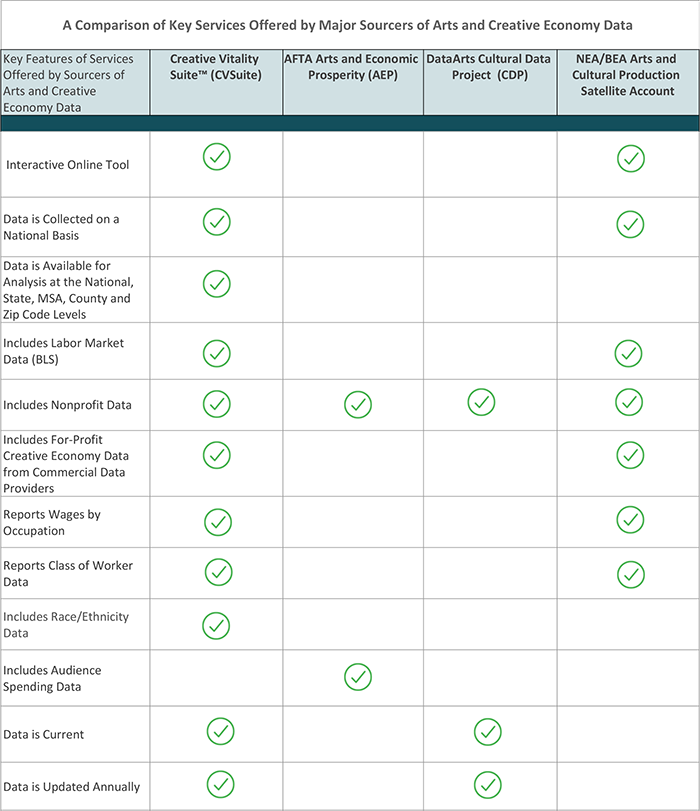
Comparison of Arts and Creative Economy Data
Below is a table of some of the major sources of data available to arts advocates today. You can use each of the sources to advocate; however, you will find that the sources have different qualities and need to be used for different purposes. Advocates should use data with knowledge of what the data are, how the data were collected, and just what the data are reporting. Not knowing these factors is an invitation to a long-term rocky relationship with elected officials and their staff.
CaFÉ 是一个在线申请提交系统,致力于通过为艺术组织提供实惠的提交平台和为艺术家提供简便的申请方式,让所有人都能获得艺术机会。

GO Smart 是一款价格实惠的资助管理软件,为资助者提供申请前和申请后表格、小组审查和数据报告。
公共艺术档案馆 (PAA) 是一个免费、可搜索且不断增长的在线数据库,其中包含美国和国外已完成的公共艺术品,以及一套用于管理公共艺术收藏的资源和工具。

ZAPP 为艺术博览会和艺术节管理员提供了一套工具,用于以数字方式收集和评审申请、管理展位付款以及与申请人沟通,所有这些都在一个易于使用的数字平台上完成。艺术家可以通过一个中央网站申请参加全国数百场展览。