






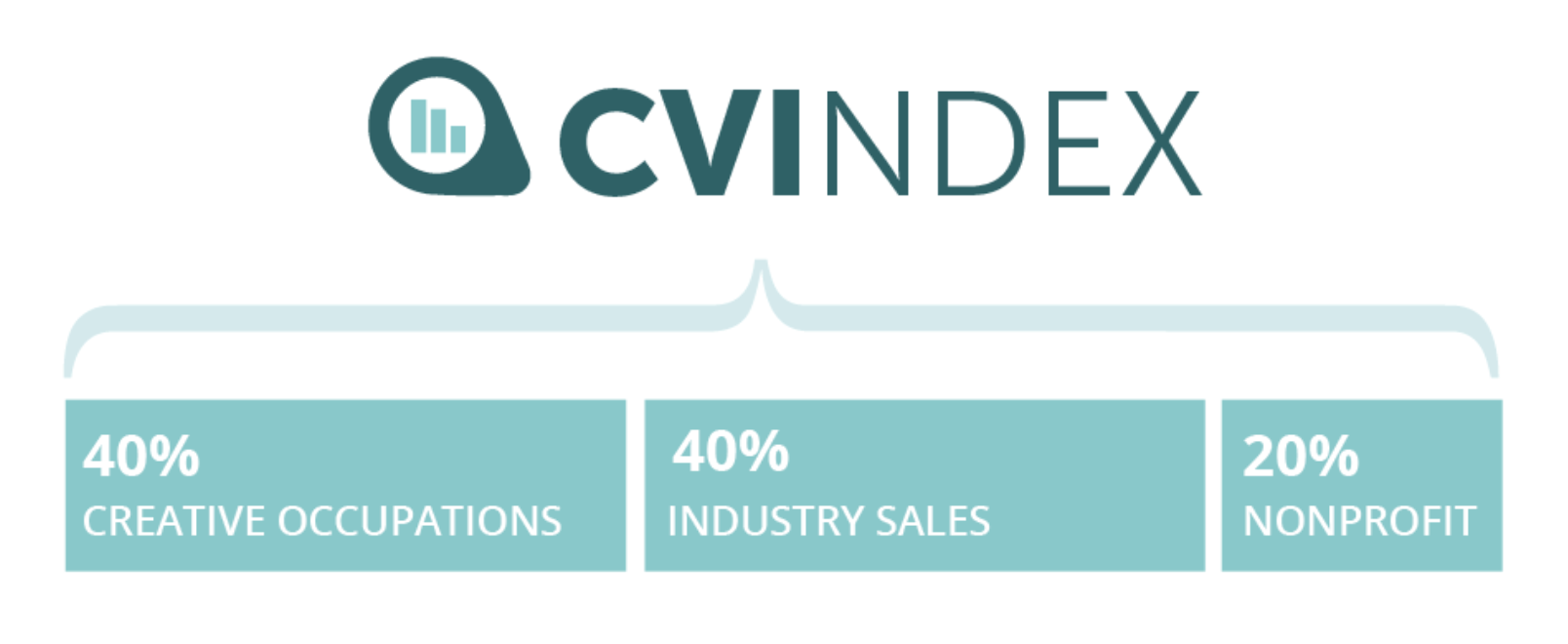
Similarly to how Body Mass Index (BMI) can serve as an approximation of your body’s health, the CVI has been designed to approximate a region’s creative economic health. The benefit of indexes like these is in their ability to quickly and simply communicate, in a single number, how many variables interact with each other.
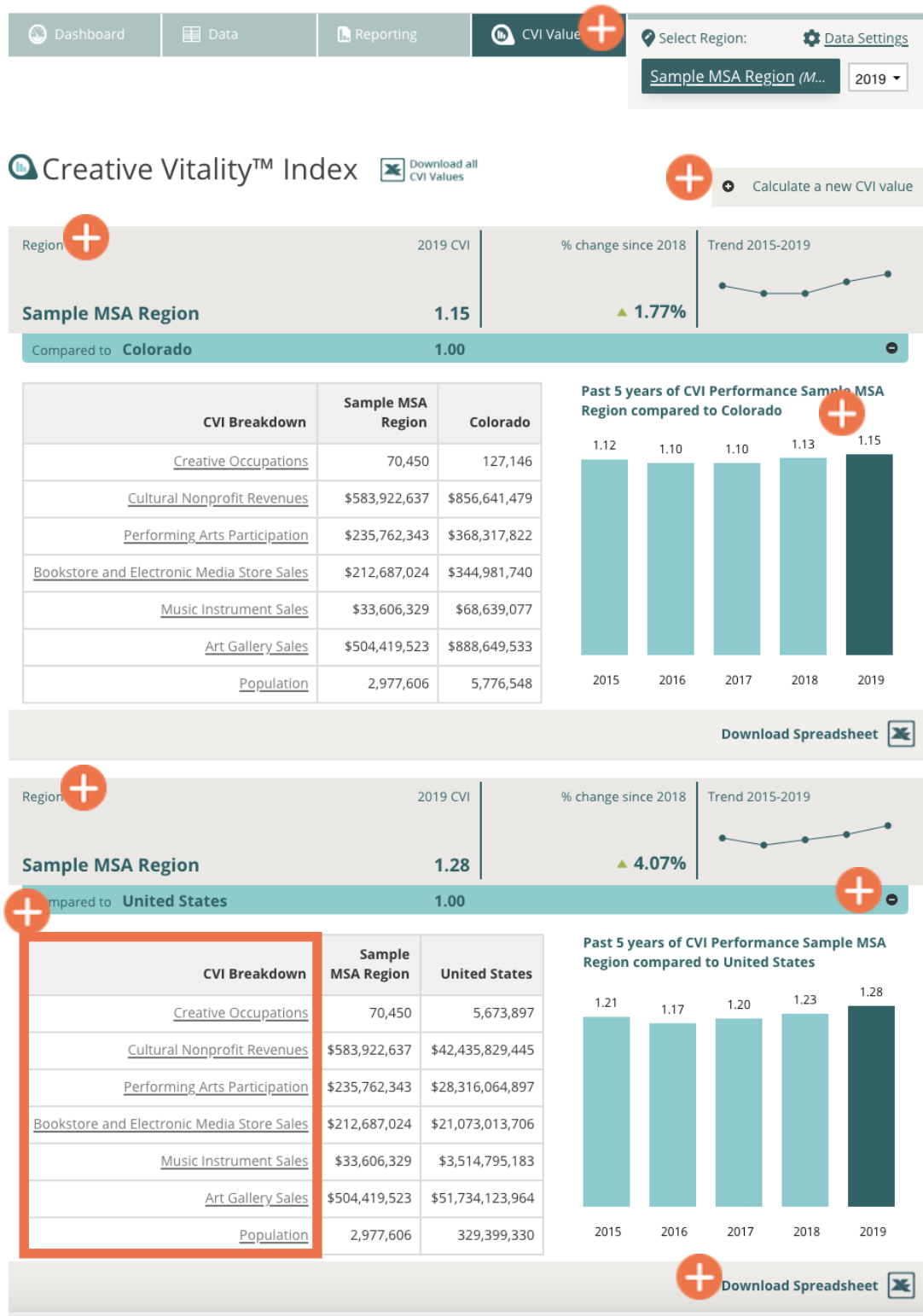
That single number, the CVI, is a ratio of all of the integrated creative economic variables compared to the United States, which has a CVI value of 1. For example, the creative vitality of a region with a CVI value of 1.5 is 0.5 times more concentrated than the national average.
The CVI has a number of uses. The Index can serve as a diagnostic tool to identify strengths and weaknesses in an area’s creative economy. From that diagnosis, community leaders can strategize to encourage growth in a particular segment of the creative sector of their local economy. The Index can also be used to benchmark work in a certain segment of the creative economy and to track progress against that benchmark. Finally, the CVI is a credible source of data that can serve as a point of departure for a discussion about the scope and relative health of an area’s creative economy with a variety of stakeholders.
CVI INDICATORS
The CVI is built from four indicators: number of jobs within specific creative occupations, industry sales from specific industries, and arts and culture nonprofit revenues.
These indicators give a broad picture of the health of a region’s overall creative economic health. Choosing the exact indicators stemmed from conversations around combining economic development and nonprofit sector methodologies to help the field better understand the creative economy. Once thought to be independent areas of study, the for-profit and nonprofit indicators were chosen due to their correlation with a region’s overall creative economic health. For the detailed list of occupations, industries, and nonprofits visit our CVSuite Codes page.
2024.1 CVI Methodology Update
With the 2024.1 update, we also updated our NAICS definition to the 2022 definition. This affects the CVI calculation in two ways:
- The CVI values for data years 2022 and 2021 will use the new 2024 methodology.
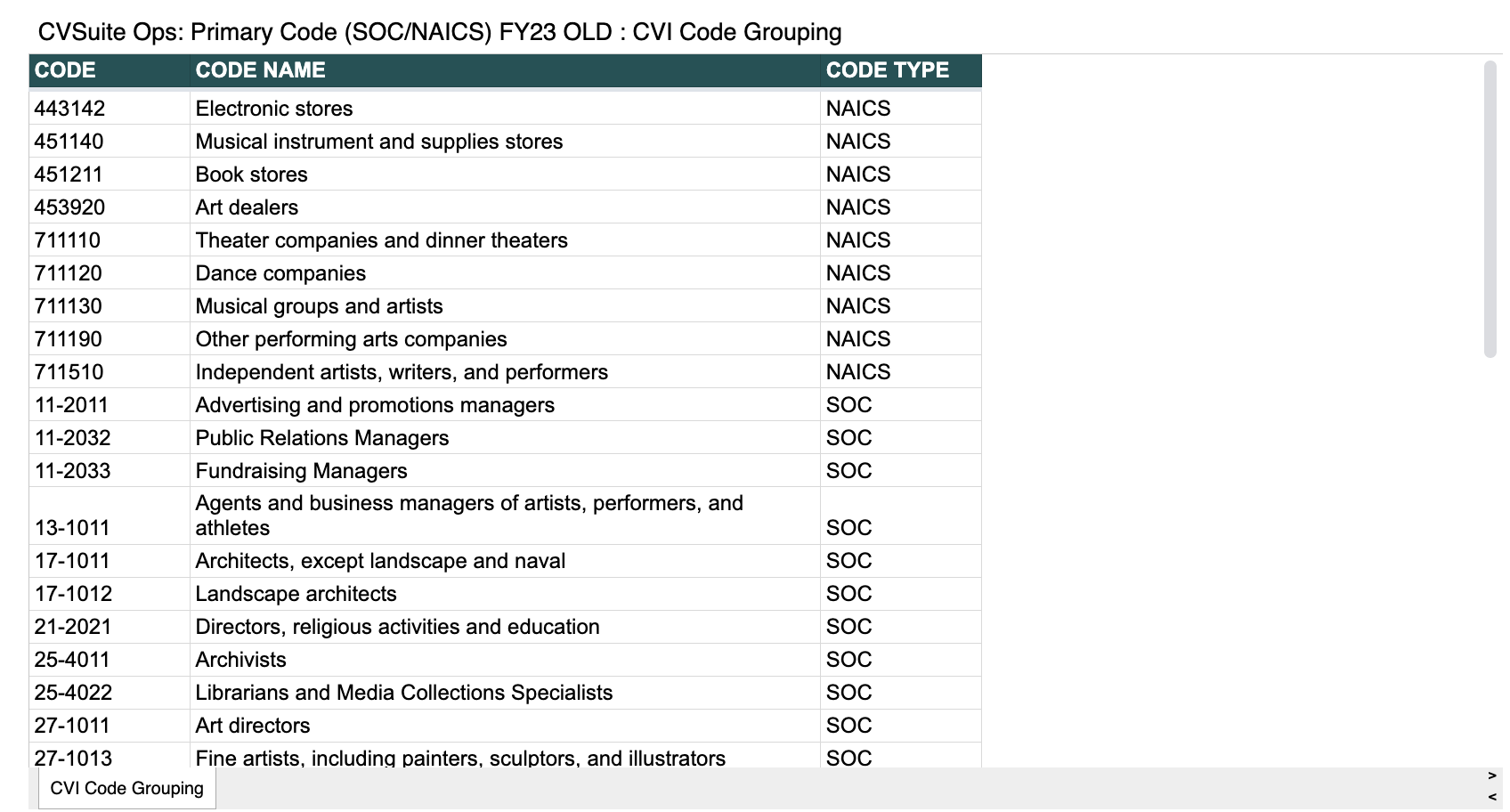
- The CVI values for data years 2020 – 2011 will use our older 2023 methodology.
2022 – 2021 CVI Values | 2024 Methodology
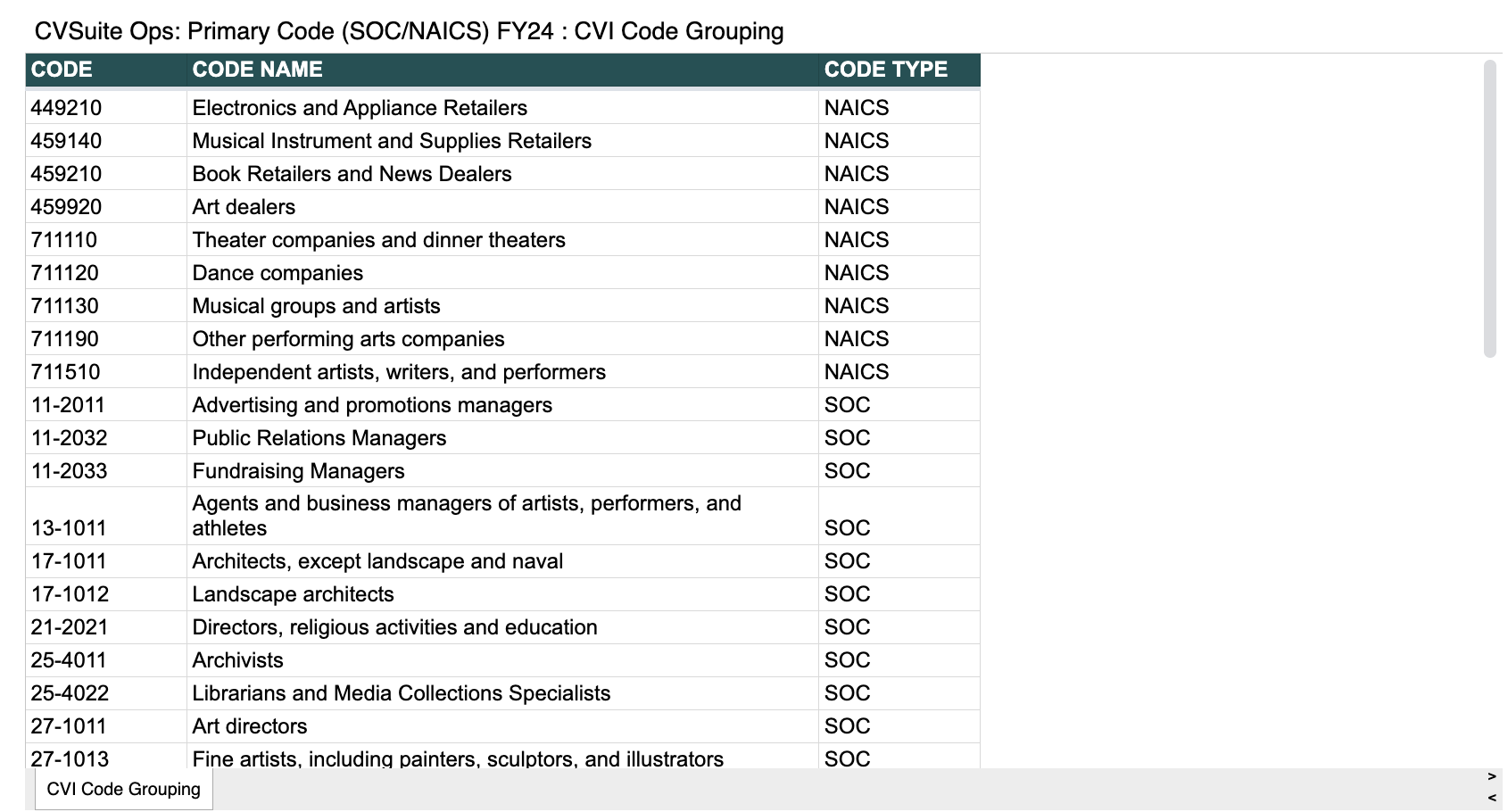
The 2022 and 2021 CVI values use our new 2024 methodology and are based on these NAICS and SOC codes: