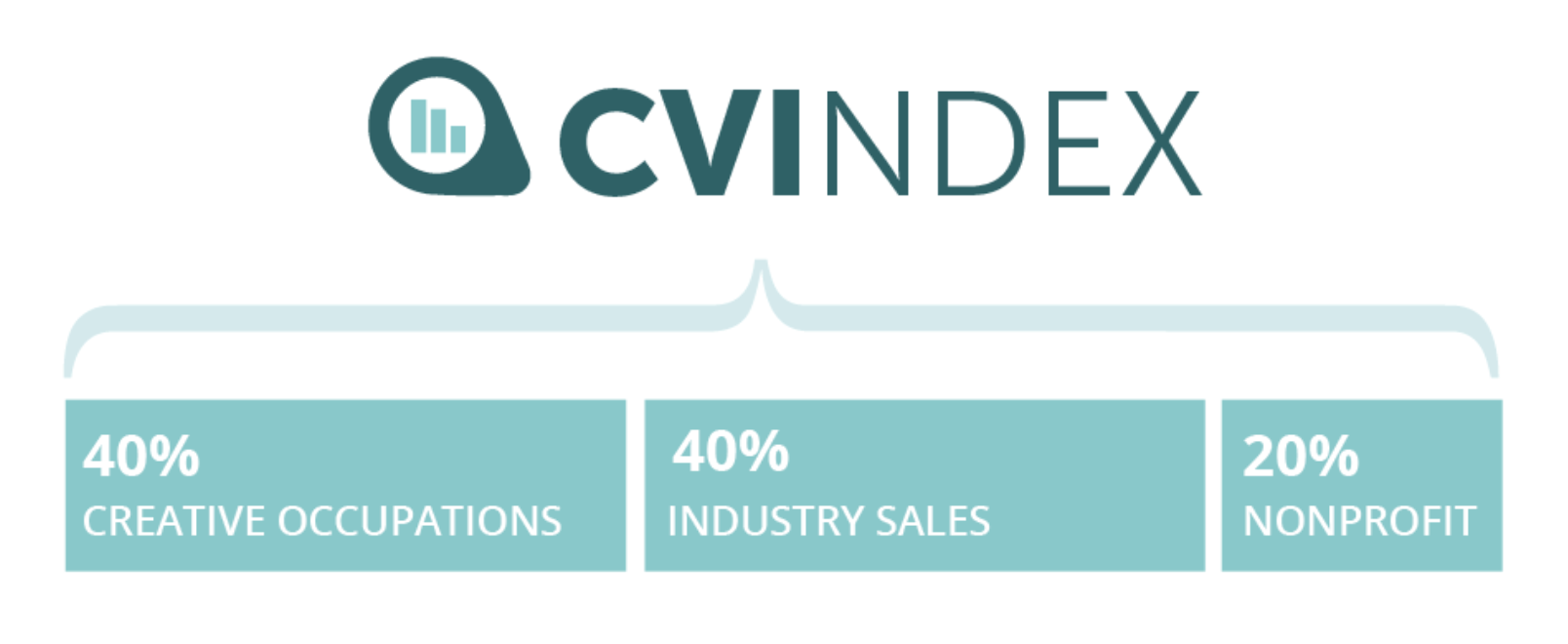
If these two phenomenon are connected in the real world, we should expect to see a positive numerical relationship (or correlation) between these factors. Not surprisingly, the correlation analysis indicates that artsy-ness is indeed positively correlated with economic growth. In other words, generally speaking, when the CVI goes up, GDP growth goes up too. Likewise, when the CVI goes down, GDP changes negatively (4).
How correlated is the CVI to other economic and geographic factors
Though this insight is interesting, it would be more interesting to measure the degree of affect that artsy-ness has on economic growth. Fortunately, regression analysis can be used to accomplish that. When conducting any regression analysis, it is important to look outside of the variable you care most about. Doing so allows you to consider the other variables that may be affecting the variable you are targeting. In this case, that variable is economic growth. We could get a lot more in-depth on this issue, but for the sake of simplicity only six other factors are considered in this data analysis. They are:
- Population
- Cost-of-living
- Diversity (measured by percentage of population that is non-White)
- Educational attainment (measured by percentage of population that possesses a bachelor’s degree or greater)
- Number of Fortune 500 companies
- Region (based on dividing the nation into five geographic areas)
This time the results are different. Our statistical model still indicates that artsy-ness has a positive affect on economic growth, but the relationship is not strong enough to state the degree of connection with any level of confidence (5). The model indicates that some factors have a very positive influence on economic growth, such as high educational attainment and being located in the southeastern region of United States. There is also one factor that has a very negative effect on economic growth, namely, being located in the northeastern United States.
What all this indicates is not that artsy-ness is irrelevant to economic growth, rather that there are other factors that are more impactful, such as geographic location and educational attainment rates. However, at this point, it is worth considering the options local organizations have for stimulating economic growth. Picking up a city and re-depositing it in a southeastern location, like Texas, is certainly not an option. Increasing educational attainment is possible, but likely an expensive one. On the other hand, supporting and promoting an existing arts culture is something within the reach of nearly any organization interested in stimulating growth.
The regression model indicates that not every city with strong growth has a strong artistic culture, but there certainly are some cities that have made arts a significant pillar of their growth strategies. A few of these cities are highlighted below.
Minneapolis-St Paul
The Minneapolis-St. Paul metro area has successfully integrated a booming arts and culture scene with a strong degree talent recruitment, which is necessary to feed the numerous large companies in the area. The region has an above-average CVI value of 1.43, while at the same time is home to 16 Fortune 500 companies and has recruited 13,200 knowledge class jobs to the economy between 2000 and 2010 (6). The region has actively highlighted the vibrant cultural atmosphere to attract people and companies to the area. Numerous independent artists are in the process of mapping out the creative strategy of the region, which can be seen at www.creativeminneapolis.org. El City of Minneapolis also sponsors several placemaking collaborations.
Denver
The Denver metro area has a strong arts scene indicated by its above-average CVI value of 1.24. The city has leveraged its arts culture into attracting talent to the area. For example, the area added 9,600 knowledge class jobs to the city from 2000-2010, which was associated with an increase of $709 million in income (7). The city has emphasized ambitious public art efforts and has developed an aggressive art/culture strategic framework in their “Imagine 2020” website.
Nashville
Nashville has leveraged its musical history and art scene as major tools for recruiting talent to the region. The success of this effort is indicated by its CVI value of 2.15, the 3rd highest value among all cities measured by the CVI. Nashville also serves as an interesting counterpoint to other cities that have seen strong economic growth, in that there is not an unusually high proportion of college-educated people. Only 21% of the metro area’s population possess a bachelor’s degree or higher. By comparison, Denver and Minneapolis are at 27% and 26%, respectively. In Nashville, the Mayor’s Office of Economic & Community Development highlights Creative Economy & Placemaking and the Music City Music Council as some of its priorities. To learn more, review the Metropolitan Nashville Arts Commission’s Culture Here: A Report on Cultural Assets and Activities.